
 Hermann Preisl

Brass instrument acoustics: the Brassissima project
 BRASSISSIMA · INDEPENDENT ACOUSTICS RESEARCH
It begins with music
Shaping a sound, carrying a phrase and bringing music to life together: for me, this is the fascination of playing a brass instrument.
Creating a tone through breath, lips and listening, then learning to shape it with growing confidence, is an absorbing challenge. Practice opens up new colours and expressive possibilities. I am fascinated by how sensitively player and instrument interact.
Music is at the heart of this project. That enjoyment and curiosity drive Brassissima. Careful measurements and models help me understand the properties of instruments and explore their musical possibilities more deliberately. Whether a change is useful also depends on the sound, expression and playing feel a musician is seeking.
Start with the four new videos
The series builds progressively: watch Videos 1 → 2 → 3 → 4. Videos 1 and 2 establish the acoustic foundations; Videos 3 and 4 extend the investigation to complete trumpets and their valvepaths. Narration is in English, with German subtitles.
For clear diagrams and labels, please select 1080p (Full HD) in the YouTube video quality settings whenever available.
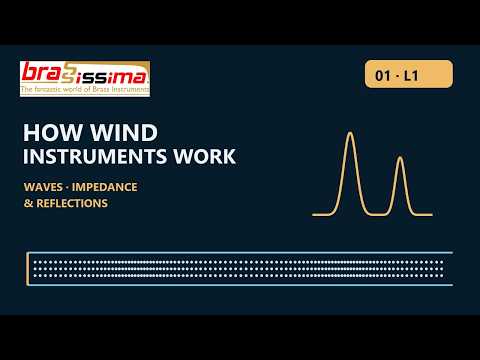 VIDEO 1
1. Waves, impedance and reflections
How waves propagate in a tube closed at one end, reflect and form resonances.
Watch on YouTube ↗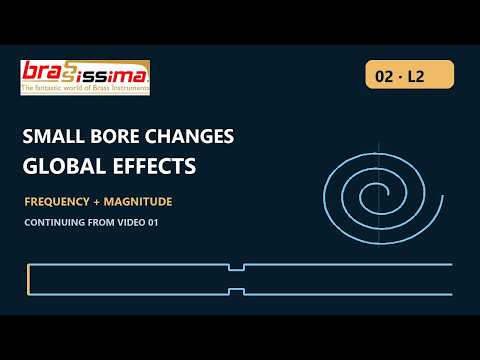 VIDEO 2
2. Local perturbations of a cylinder
A local expansion or constriction: how does its position influence frequency and magnitude?
Watch on YouTube ↗ VIDEO 3
3. From simple geometry to the trumpet
The mouthpiece, leadpipe and bell shape the sensitivity of resonances in a complete instrument.
Watch on YouTube ↗ VIDEO 4
4. Eight valve paths and their node families
Shared tube sections, local changes and the position of the valve cluster in combination.
Watch on YouTube ↗Watch the Brassissima Project playlist →
From playing to understanding
How do the mouthpiece, leadpipe, bell and valvecluster position influence an instrument? What happens when a small, local change is introduced into its bore? Brassissima brings together my experiments, measurements and simulations to investigate these questions and develop a systematic basis for optimization. There is no single optimal trumpet for every purpose: the objectives must be defined first.
I have been exploring these questions since 1999, with renewed, intensive research since 2017. Alongside my work solving computer problems, I develop measurement tools and analysis software and study acoustic models of brass instruments.
Shared foundations of wind instruments
Oscillating air columns, the propagation and reflection of pressure waves, and resonances are relevant to wind instruments generally – including woodwinds such as the flute, clarinet and saxophone. This is why the investigation starts with simple tubes and fundamental relationships.
Excitation mechanisms and the effects of tone holes, mouthpieces and openings differ between instrument types. Specific results therefore need to be checked for each design. My research focuses on brass instruments, often using the trumpet as a manageable example.
A new chapter from 2026
Years of experimental work are now being reviewed, updated and presented in a clearer form. Some subjects are best explained through illustrative videos: movement, wave patterns and the effects of a changing perturbation position become visible. Other topics need detailed derivations, measurement procedures and extended analyses; these remain the domain of PDF documentation.
The project is continuously evolving. Ongoing work focuses on current technologies and the latest research findings. Videos and PDFs complement each other; current publications are clearly separated from earlier work.
The transition to a unified presentation takes place step by step. “Legacy” refers to earlier stages of the work, not inherently incorrect content. Findings that remain relevant are incorporated into the revised publications; the earlier versions are then removed. The transition is complete only once this replacement has been completed.
Four distinct project objectives
- A
Theoretical and practical foundations
Understand fundamental acoustic relationships, describe them theoretically and investigate them through practical experiments. These foundations provide the common basis for the other project objectives.
- B
Measurement and evaluation of existing instruments
Measure and analyse existing instruments using current methods, then assess them against defined criteria. This area first documents and evaluates the instrument as it is.
- C
Optimization of existing, measured instruments
Use the measurement and evaluation results to develop targeted changes, simulate their effects and verify them in practice. Optimization objectives are defined for the particular instrument and its intended use.
- D
Development of new possibilities
Research and develop new geometries, concepts, methods and tools. This area extends beyond evaluating and optimizing instruments that already exist.
Explore the six sections
The project overview and all six section pages are available in German and English. The underlying documents retain their original languages and are being progressively revised and developed. Videos are accompanied by German translations; German subtitles are available for the four published episodes. Each PDF entry explicitly identifies its language, original level and publication status.
Acoustic foundations
Simple waveguides, reflections and local perturbations. Videos 1 & 2.
Brass instruments: simulation and theory
Complete instruments, shared valvepaths and node families. Videos 3 & 4.
Measurement reports and optimization projects
Instrument reports, measurements and documented optimizations.
Questions, observations or ideas? I welcome your feedback: brassissima@preisl.at